
PHP Sessions and Cookies
When working with Web Applications, each request to the Web Server is independent of each other. HTTP is a stateless protocol so it does not know one request to another. In PHP, there are two ways to keep state between requests. PHP sessions and cookies are the mechanisms to keep state. In this lab you will learn how to use PHP sessions and cookies.
outcomes
In this lab, you will learn to:
- Use PHP sessions.
- Use PHP cookies to remember users.
- Use PHP sessions and cookies as an access control mechanism.
videos:
Before you start this lab, review these videos.
Overview
The development of this document is funded by the Boston Area Advanced Technological Education Connections (BATEC) Grant No. NSF-0703097 thru Bunker Hill Community College.
HTTP is a stateless protocol that uses TCP as its transport to ESTABLISH sessions between a client and a server. The word stateless implies that the protocol will not remember any user from one session to the next. Each time your browser refreshes or you navigate to a different page, a new session is established. Code adjustments must be made to counteract this behavior, such as with PHP sessions and PHP cookies. In this lab, we will implement both PHP sessions and cookies.
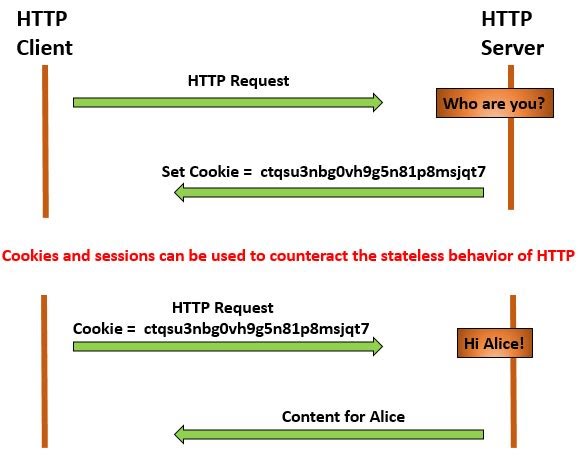
PHP Sessions and Cookies