
Exploring HTML

Hypertext Markup Language (HTML) is the basic building blocks of a Web page. Any time you request a Uniform Resource Locator (URL) in your browser, a web page that consists of HTML that tells a Web Browser how to render the page in the Browser. As an ethical hacker, you need to understand the structure of HTML and it’s vulnerabilities so you can better protect web pages.  

outcomes

In this lab, you will learn to:

  1. Understand the basic structure of a web page.
  2. Understand the attributes within an HTML element.
  3. Understand the table and form tag in HTML.
  4. Understand how forms work which plays a key role in facilitating the transfer of data that has been submitted within the UrBank form. 

Videos

Before you start this lab, review these videos.

Exploring HTML

APA Template Shortcut

Creating APA Title Page

Creating APA Headings Using the Styles Menu

Creating APA Table of Contents

Overview

To understand where the vulnerability exists within a system, you have to know how the system works. In future exercises, we will pentest through this HTML form (the yellow login box). Thus, we need to know how the HTML form works. In this section, we will examine and discuss the elements that make up the HTML form.
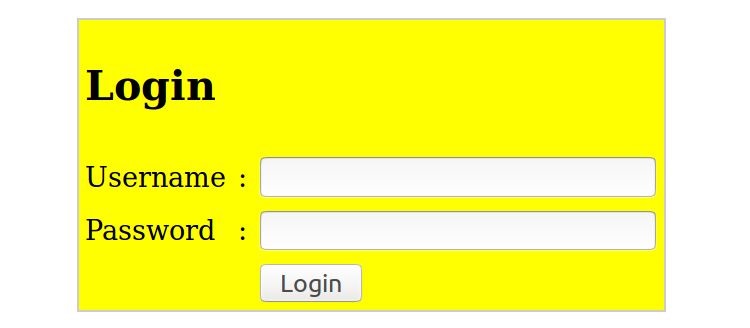
image001.jpg

HTML Form

Key terms and descriptions

HTML
Hypertext Markup Language is a markup language that tells browser how to render a web page.
HTTP
Hypertext Transfer Protocol is the way web browsers and server communicate with each other.
PuTTY
PuTTY is a terminal emulation software that can be used to access Unix-like systems from Windows and other Linux systems like Ubuntu.
Web browser
A web browser is a software application for accessing information on the World Wide Web. It consists of a graphical user interface (GUI) that renders HTML, CSS, and other web page content according to the standards of the World Wide Web Consortium (W3C).
Web server
A web server is a computer that provides the content for a website. It is a computer that is connected to the Internet and can be accessed by other computers on the Internet. Web servers are usually powerful computers with large amounts of storage space and RAM, which store all of the data for a given website.